

Media release

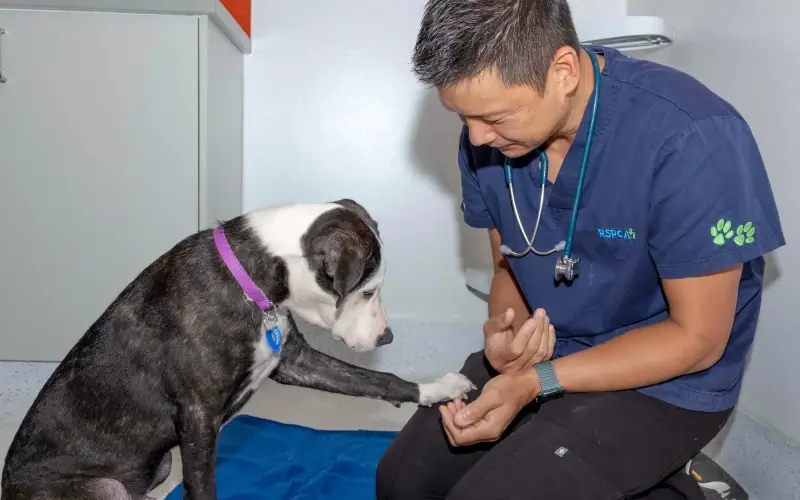
Rising vet costs and low insurance uptake put veterinary services under extreme pressure.
The cost-of-care crisis
Veterinarians have raised concerns about a growing cost-of-care crisis, warning that financial constraints are increasingly dictating medical decisions for companion animals. This issue has been brought into sharp focus at the launch of the new RSPCA Pet Insurance, alongside new RSPCA research conducted, showing that one in three Australian pet owners have delayed vet care because they couldn’t afford it.¹
The four veterinarians who addressed this issue at the launch, agreed that pets with treatable conditions are increasingly missing out on care as owners are forced to delay, scale back or forgo treatment altogether.

1 in 3
Australian pet owners have delayed vet care due to cost.¹

1 in 5
Australians are not confident they could afford emergency vet expenses.¹

51%
of pet owners cite serious illness or injury as their biggest concern.¹
The reality facing vets
“One of the most challenging parts of our job is not performing surgery or treating illness, but discussing treatment costs with distressed owners. In everyday veterinary practice, we often need to present different levels of care, from baseline through to optimal treatment. Optimal care delivers the best possible outcome, but it is costly. These financial discussions are emotionally challenging for the entire veterinary team and we see the impact daily on both the pets and their devastated owners.”
Dr Melissa Meehan – RSPCA Victoria Director of Veterinary Services
Unlike Medicare for humans, there is no public funding to support pet healthcare, leaving thousands of Australian families exposed when they cannot afford treatment for their companion animals.
“Veterinary care has advanced significantly in recent years and this level of care comes at a price that can put a real financial strain on pet owners. If pets are insured we can focus on what’s best for the animal rather than what the owner can afford. Insurance removes the need to compromise care.“
Dr Andrew Marchevsky – Small Animal Surgical Specialist & Co-owner, SASH Vets
Behavioural care and the limits of what families can afford


Behavioural care and the limits of what families can afford
Sydney behaviour vet and registered dog trainer, Dr Emily Lucas, added that certain behavioural conditions – often highly treatable – can become a financial burden when ongoing intervention is required. “When multiple sessions are recommended, some pet owners simply cannot commit to the cost. In some cases this can lead to difficult outcomes, including surrendering pets to the RSPCA. Access to comprehensive insurance, particularly with no sub-limits, can make a big difference in enabling ongoing behavioural care.”
It’s not just families who are affected, with the emotional burden shared by veterinarians who must balance empathy for the owner, advocacy for the animal and hard financial realities.
“When a case carries a good prognosis but cannot proceed due to money, the impact lingers. For vets, these situations hurt, particularly when the medical outcome could have been very different with earlier or more accessible treatment,” Dr Meehan notes. “Over time, repeated exposure to these situations can contribute to emotional fatigue and burnout.”
The question pet owners should be asking
For decades Dr Katrina Warren, one of Australia’s most trusted television veterinarians, has seen the consequences first-hand. She welcomes better options contributing to improved care. “Vets are always relieved when pet owners have insurance and having the right cover gives pet owners peace of mind. The question shouldn’t be whether you can afford pet insurance, rather whether you can afford not to have it?”
Dr Katrina Warren – Veterinarian & Television Presenter
Research reveals cost pressure cuts across all income levels
The RSPCA-commissioned research also highlighted that delaying vet care is affecting Australians across all income levels. Around one in four households earning $699 per week have delayed care, while the figure rises to one in three among those earning over $3,000 per week. One in five Australians are not at all confident they could afford emergency veterinary expenses. The biggest concerns for pet owners are:


Brad Smith – CEO, RSPCA Pet Insurance
A new approach to pet insurance: flexible, accessible, purposeful
“This confirms the challenging situation facing pet owners and vets today. That’s why we’re working to make pet insurance more accessible than ever. At the heart of the new RSPCA Pet Insurance is a customisable protection plan enabling customers to tailor a policy to their pet’s needs and budget, rather than being limited to rigid pre-packaged tiers.”
“We’ve also developed ‘Direct2Vet’, a solution to simplify the claims experience for both veterinary clinics and pet owners. With this system, which is similar to Medicare and HICAPS used in human healthcare, customers pay only the difference between their veterinary bill and eligible insurance cover at the time of their visit, with approved claims paid directly to the practice. Direct2Vet helps remove financial friction, giving pet owners greater confidence to seek timely care while supporting clinics to focus on treatment.”
Brad Smith – CEO, RSPCA Pet Insurance
The key to responsible pet parenting
“I’d encourage Australians to seriously consider pet insurance as a way to protect both their pet’s health and their own financial wellbeing. It really is what I’d like to call responsible pet parenting.”
Dr Katrina Warren – Veterinarian & Television Presenter
Explore RSPCA Pet InsuranceAbout RSPCA Pet Insurance
RSPCA Pet Insurance is a purpose-driven strategic partnership between RSPCA Australia and Pacific International Insurance, designed to protect and improve the wellbeing of pets while also helping contribute funding to RSPCA animal welfare initiatives nationwide. With over 150 years of RSPCA expertise in animal care, advocacy, and veterinary knowledge, our customisable product offers transparent, flexible coverage that can be tailored to pet owners’ needs and budgets, with premiums helping support RSPCA initiatives such as rescue, rehabilitation, rehoming, education, and law enforcement efforts for animals in need. Guided by a vision of a world where pets can live well and be well, RSPCA Pet Insurance combines empathy, expertise, and innovation to help make pet insurance accessible and impactful. For more information, visit rspcapetinsurance.org.au
Media contacts:
Leandri Smith | Evolab | leandri@evolab.com.au | 0433 900 356
Azelle Evans | Evolab | azelle@evolab.com.au | 0451 710 095
References:
- The RSPCA polling was conducted by McCrindle Research and was in the field from 11 to 23 March 2026. A nationally representative 1,014 Australians were surveyed.
